

Defending Medicaid
Last Updated on June 10, 2026
From the beginning as H.R. 1 was taking shape, our Defending Medicaid page has served as a hub of advocacy resources for state and national partners, providing context to the critical need that Medicaid serves and the dire impacts of rushed cuts to the program. As states begin to implement the law in 2026, Families USA continues this work. Below, you will find featured resources and analyses along with ways to get involved and push back against H.R. 1’s cuts to health care access and coverage.
Medicaid provides critical health care to millions of children, families, older adults, and people with disabilities. Through the 2025 Republican-led budget reconciliation legislation, H.R. 1, Congress enacted policies that drastically cut the Medicaid program and will result in coverage losses for millions of people by increasing red tape and paperwork burdens.
Significant health coverage losses — particularly among those enrolled in their states’ Medicaid expansion programs — are a consequence of the laws requirements like incredibly restrictive work reporting requirements, mandatory cost-sharing, and more frequent redeterminations of Medicaid eligibility.

Call To Action
Send a message to Congress telling them to protect Medicaid!

Latest press releases on all Families USA activities.
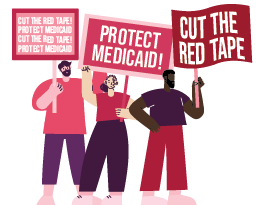
Push Back Against Work Reporting Requirements!
FEATURED RESOURCES



Table of Contents
Click on the links below to jump directly to the issue area or resource section.
WORK REPORTING REQUIREMENTS
Among the many provisions in H.R. 1 that gut Medicaid, one of the most consequential is work reporting requirements (also known as “community engagement” requirements) to be implemented by January 2027. H.R. 1 requires applicants and enrollees aged 19–64 covered by Medicaid expansion to document they work or participate in “community engagement” activities for at least 80 hours per month, or that they qualify for an exemption (such as having a serious medical condition or being a full-time caregiver).
The burden of additional paperwork to prove hours worked or various exemptions makes it much harder for working adults, caregivers, and people with disabilities to maintain their Medicaid coverage. Families USA previously broke down why work reporting requirements are a solution in search of a problem, when at least 8 in 10 Medicaid enrollees would meet work or exemption criteria.
The significant paperwork burden of work reporting requirements along with more frequent eligibility checks means that at least three million and up to 10 million people will lose Medicaid coverage — not because they no longer meet the program’s requirements, but because they cannot jump through administrative hurdles and red tape.
In addition, states now have an enormous task ahead to: (1) set up new systems to determine eligibility and efficiently approve compliance or exemption within a compressed timeline and (2) conduct robust outreach to enrollees about policy changes and what individuals must do to remain covered.
The range of coverage loss in any state will depend on their implementation choices and how well each state can pull together new enrollment systems that adequately determine eligibility and keep vulnerable populations covered. Advocates can make the case for states to continue to learn from past states’ experiences, bolster the Medicaid program and its impact on the state’s health care system, and work closely with a wide range of stakeholders — including Medicaid enrollees and their families, hospitals, community health centers and other Medicaid providers, patient advocacy organizations — to learn about the real, ongoing impacts of implementation decisions.
Advocates Can Impact State Implementation Decisions to Ensure Eligible Populations Stay Enrolled
H.R. 1 offers states several key flexibilities to make operational choices that help reduce the complexity and burden of work reporting requirements, ultimately making it easier for eligible people to obtain and maintain coverage and the state to administer the program. These include:
- Requiring applicants and existing enrollees to show only one month of compliance at application/renewal
- Verifying compliance only at renewal rather than more frequently
- Allowing individuals to self-attest to work or exemptions where possible
- Implementing ex parte (automated) renewal systems
- Strategically engaging impacted communities
As states review federal guidance on work reporting requirements (released June 2026), states are making important implementation decisions now. For example, states are passing laws to require Medicaid applicants/enrollees to show three months of compliance, verify their compliance more frequently, and limit or prevent self-attestation. In addition, some states — including Nebraska, Montana, and Arkansas — are pushing forward implementation ahead of the already compressed timeline required by H.R. 1. If states rush implementation and make more punitive implementation decisions, Medicaid expansion-eligible communities will have to overcome significantly greater administrative hurdles to achieve and maintain coverage.
State advocates can help raise concerns with state Medicaid officials and other policymakers about rushed implementation and implementation choices that make the already burdensome work reporting requirement process even more challenging for eligible applicants and enrollees.
In addition, advocates can push back against work reporting requirements right now and through 2026, as early implementation begins and as all states head toward a January 2027 start date. We encourage advocates to build the following key moments in the implementation timeline into your advocacy campaigns and partner activations. You can also utilize the resources below, which will be updated throughout the upcoming months.
| Key Moment | Timing | Related Resources |
|---|---|---|
| State contracting and administrative decisions | Ongoing, through 2026 | Assessing the Medicaid Work Requirement Vendor Landscape, CBPP |
| Work Reporting Requirements Interim Final Rule with Comment (IFC) | Released June 1, 2026 | Send a message to Congress about state readiness, forthcoming |
| 1-year anniversary of H.R. 1 | Week of July 4, 2026 | |
| Notices sent to enrollees subject to work reporting requirements | Fall–Winter 2026 (varies by state) | |
| States may begin applying for good faith exemptions | Fall–Winter 2026 (varies by state) | |
| Work reporting requirements go live and enforcement begins in all states | January 1, 2027 | |
| First terminations begin in all states | March 2027 |
More Advocacy Resources
- Medicaid Work Reporting Requirements: Bureaucratic Burdens That Threaten Working Families, Providers and Local Economies, Families USA.
- A Guide to Reducing Coverage Losses Through Effective Implementation of Medicaid’s New Work Requirement, CBPP.
- Projected Reductions in Medicaid Expansion Enrollment Under OBBBA’s Work Requirements and Six-Month Redeterminations, Urban Institute.
FACT SHEETS AND ANALYSES
Dangerous Medicaid cuts will result in millions of Americans losing their health care, harming family financial security and devastating state and local economies. These fact sheets delve into a range of topics from populations that rely on Medicaid, the greatest threats faced by the program, and more.
- *NEW* Medicaid Managed Care: Top Issues for Advocates in 2026
- Continued Financial Costs of Mississippi’s Inaction on Medicaid Expansion
- Continued Financial Costs of Alabama’s Inaction on Medicaid Expansion
- H.R. 1 – Provisions Section-by-Section Summary and Analysis
- Summary of Harmful Impacts of Trump’s Health Care Cuts
- Senate and House Text Section-by-Section One Big Beautiful Bill Act
- Working America Relies on Medicaid: Congress Must Protect Essential Workers from Devastating Medicaid Cuts
- Federal Medicaid Cuts Would Force Rural Hospitals to the Brink of Closure
- Congress’ Provider Tax Proposals Would Be A Huge Blow to State Budgets
- Harmful Impacts of Proposed House and Senate Budget Bills: What Is at Stake for the 10 States That Have Not Yet Expanded Medicaid
- Medicaid Expansion Reduces Maternal Mortality: Medicaid Cuts Would Be Deadly for Mothers and Babies
- Medicaid Matters: To People, Our Economy and the Health Care System
- Medicaid Work Reporting Requirements: Bureaucratic Burdens That Threaten Working Families, Providers and Local Economies
- Medicaid Cuts Would Rip Away Health Coverage from Millions of Americans, Disproportionately Harming People of Color
- Medicaid Federal Funding: Cuts to Federal Share (“FMAP”) Hurt Families, Providers and State Economies
- Medicaid Provider Taxes: Restricting Them Threatens Hospitals, the Health Care System and State Economies
LOCAL FACT SHEETS
To assist in efforts to Call on Congress following the passage of devastating Medicaid cuts, please utilize our series local fact sheets. We hope the data and talking points included in these fact sheets can be used to apply pressure to target members of Congress — reminding them that the Medicaid program is the bedrock of our health care system and they have a responsibility to their constituents. Should you have any questions about the data, please don’t hesitate to reach out to our team at: governmentrelations@familiesusa.org.
State-Level
District-Level
- AK-01 Rep. Begich (Graphic)
- AZ-01 Rep. Schweikert (Graphic)
- AZ-06 Rep. Ciscomani (Graphic)
- CA-22 Rep. Valadao (Graphic)
- CA-40 Rep. Kim (Graphic)
- CA-41 Rep. Calvert (Graphic)
- CO-03 Rep. Hurd (Graphic)
- CO-08 Rep. Evans (Graphic)
- FL-27 Rep. Salazar (Graphic)
- IA-01 Rep. Miller-Meeks (Graphic)
- IN-05 Rep. Spartz (Graphic)
- MI-07 Rep. Barrett (Graphic)
- MI-10 Rep. James (Graphic)
- NE-02 Rep. Bacon (Graphic)
- NY-01 Rep. LaLota (Graphic)
- NY-02 Rep. Garbarino (Graphic)
- NY-11 Rep. Malliotakis (Graphic)
- NY-17 Rep. Lawler (Graphic)
- NJ-02 Rep. Van Drew (Graphic)
- NJ-04 Rep. Smith (Graphic)
- NJ-07 Rep. Kean (Graphic)
- OH-14 Rep. Joyce (Graphic)
- OR-02 Rep. Bentz (Graphic)
- PA-01 Rep. Fitzpatrick (Graphic)
- PA-08 Rep. Bresnahan (Graphic)
- TX-15 Rep. De La Cruz (Graphic)
- TX-23 Rep. Gonzales (Graphic)
- VA-01 Rep. Wittman (Graphic)
- VA-02 Rep. Kiggans (Graphic)
- WA-04 Rep. Newhouse (Graphic)
- WA-05 Rep. Baumgartner (Graphic)
Download Social Media Graphics
Click the link to download the corresponding graphic or download all social media graphics.
FEDERAL COMMENTS & STATE-LEVEL TESTIMONY
At the federal level, the Trump administration may take executive action to change existing policy through a notice of proposed rulemaking (NPRM) process or the Centers for Medicare & Medicaid Services (CMS) may provide an open comment period on state 1115 waiver applications following a state comment period (see below). Submitting comments is one way for organizations and individual citizens to provide feedback and create a public record on issues and policies that will impact their families and their communities.
Similarly, at the state level, providing written testimony is one way for organizations and individual citizens to weigh in on the legislative process directly once bills are being heard in a committee after bill introduction. Written testimony (sometimes accompanied by oral testimony provided during the hearing) also provides feedback to legislators and state agency staff and creates a public record on issues that matter to state residents.
Should you have any questions on our submitted comments, state-level testimony or if you are looking for technical assistance to write your own, please reach out to healthpolicy@familiesusa.org.
Interactive Map Instructions
To view a specific comment letter or testimony, hover over the state or double click to read the document.
Section 1115 State Medicaid Waiver Comment Letters & State-Level Testimony (January 2025 – Present)
View All Comment Letters & State-Level Testimony
Trouble accessing the map? Review all comment letters and testimony by clicking the dropdown below.
- Nebraska's Proposed Section 1115 Demonstration Waiver
- Maryland's 1115 HealthChoice Demonstration Extension Application
- Montana's Health and Economic Livelihood Partnership (HELP) Section 1115 Demonstration Waiver
- South Carolina’s Proposed Medicaid 1115 Demonstration Waiver
- Maine’s Whole Person Care Waiver
- Iowa's 1115 Demonstration Amendment
- Georgia's 1115 Demonstration Waiver Extension Request
- Missouri's 1115 Waiver Extension Application
- Ohio Department of Medicaid’s (ODM) Group VIII Demonstration Waiver
- Colorado’s “Expanding the Substance Use Disorder (SUD) Continuum of Care” 1115 Medicaid Demonstration Extension Request
- Arizona’s Section 1115 Waiver Amendment for AHCCCS Works Program
- Arkansas' ARHOME Medicaid Waiver Amendment
ADDITIONAL RESOURCES
Following the passage of the final budget bill that guts funding for Medicaid, terminates health care coverage for at least 17 million Americans and increases health care costs, it is helpful for researchers, advocates and other stakeholders to have access to the latest research and data on the Medicaid program.
This bibliography of resources pulls together current studies, reports and data analysis that examine: 1) the impact of various proposals to scale back Medicaid; and 2) the value Medicaid brings to the many populations it serves.