



If my son gets sick, I take him to the doctor. If I need care, I go. I don’t have to wait or worry on how I will pay for it or avoid going all together.

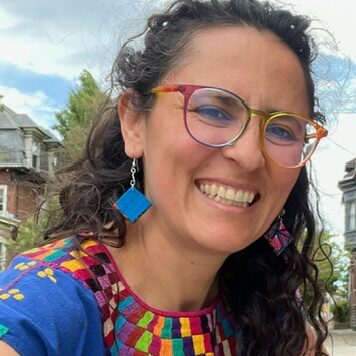
Irene Osorio is a seamstress, language justice worker, and co-op founder living in Philadelphia — and that is only part of the picture. She is also the co-parent of a 10-year-old she describes as “the love of my life and the center of my world.” A daily volunteer, and an anchor in her neighborhood network of mutual support, Irene says, “I wear many hats…I’m lucky to have many abilities and passions, but it also means I’m running around making everything happen to make ends meet.”
Most recently, Irene co-founded a language justice cooperative with three other interpreters, built on a vision of creating spaces where people who speak different languages can participate as equals, while also bringing professional standards and financial stability to their work. She is clear-eyed about what that kind of entrepreneurship requires. Anyone who has started a small business or a co-op knows the long stretch of hours invested before the income catches up: learning to make decisions collectively as co-owners, managing finances, building a brand. Some weeks are busy. Some are slower. Hours and income shift.
That variability is precisely what makes proposed work reporting requirements so concerning for someone like Irene. “My life is bigger than paperwork,” she said. For people building small businesses, work does not always fit into a simple schedule — and the documentation required to prove it might not either. She knows from her own experience navigating complex systems that administrative errors happen, that paperwork falls through the cracks, and that the consequences land hardest on people who are already working hard just to stay afloat. “We do know that people who are working hard could still fall through the cracks because of paperwork or administrative errors.”
That is where Medicaid comes in. “Medicaid gives me and my son the stability that makes everything else possible,” Irene said. She and her son are, by her account, fortunate to be healthy — they do not rely on coverage constantly. But its presence changes what is possible. “If my son gets sick, I take him to the doctor. If I need care, I go. I don’t have to wait or worry on how I will pay for it or avoid going all together.”
That peace of mind is not a small thing. It is the foundation beneath everything else she is building — her cooperative, her volunteer work, her role as a mother. “It let me focus on raising my son, growing my business, and staying connected to my community.” For Irene, Medicaid is not a safety net for a crisis. It is the stable ground that allows her to keep showing up: for her child, for her co-op, and for the neighbors she serves every day. “I’m working hard, and I’m part of building something that helps other people.” Irene hopes lawmakers will see what Medicaid actually makes possible — not dependency, but the stability that allows working people to keep contributing to their families, their businesses, and their communities.
Add your voice to help us continue to push for the best health and health care for all.
SHARE YOUR STORY